 Des Moines Egress Windows
 Window Well Installation in Des Moines
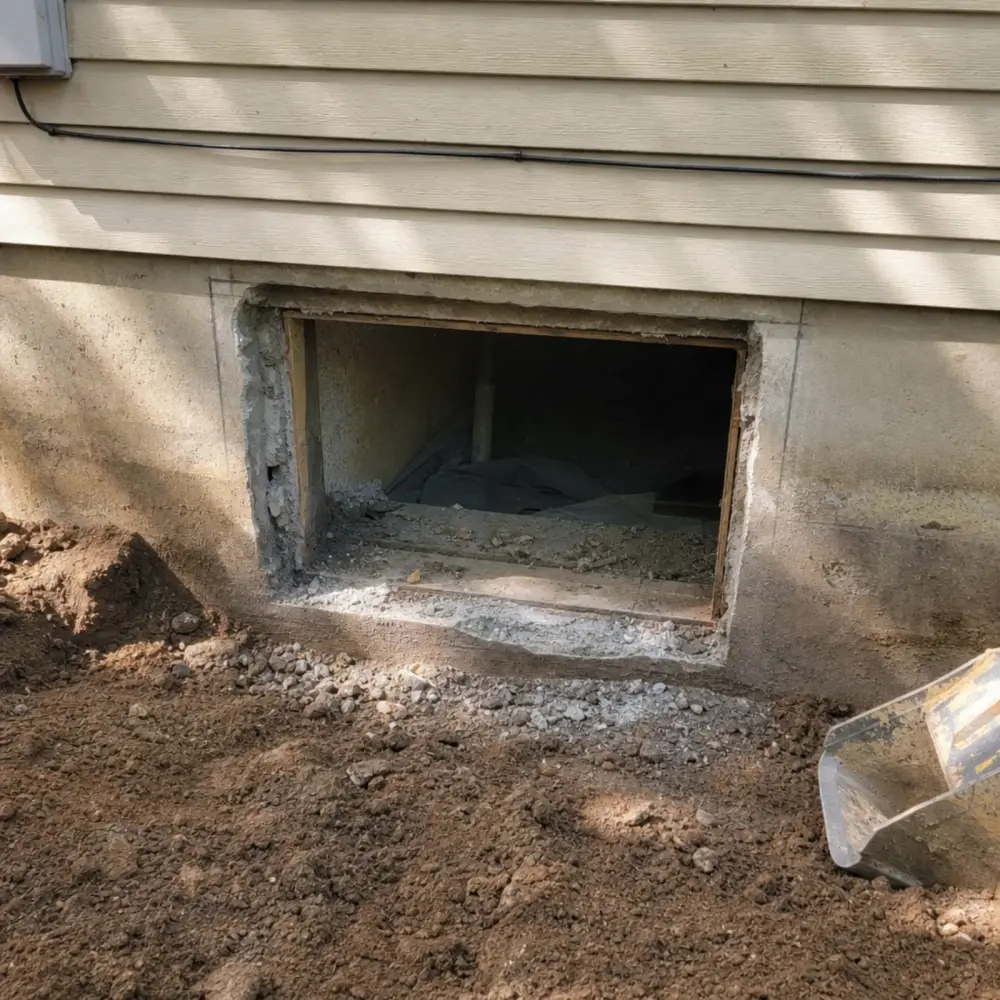
A window well is what lets a basement egress window sit below grade without letting the yard pour in - and Des Moines Egress Windows installs and replaces them to code: anchored to the foundation, sized to IRC R310, laddered when deep, and drained so they stay dry through an Iowa spring. Well replacement on an existing opening runs $1,000–$3,000; new wells are included in every full egress install.
The well is the half of the project homeowners underestimate. The window keeps weather out of the opening; the well and its drainage keep water away from the window. In this metro’s clay soil, a code-perfect window in a badly drained well is a basement leak on a delay timer.
What the code requires
For an egress opening below grade, IRC R310 - enforced across the metro through each city’s adopted residential code - requires:
- Horizontal area of at least 9 square feet
- Minimum width of 36 inches and minimum projection of 36 inches from the foundation wall
- A permanently attached ladder or steps when the well is deeper than 44 inches - rungs at least 12 inches wide, projecting at least 3 inches from the wall, spaced no more than 18 inches on center
- The well can’t block the window from opening fully, and the ladder can’t reduce the required dimensions by more than 6 inches
Most full-depth basements in Des Moines, Ankeny, Johnston, Urbandale, and West Des Moines put the sill low enough that the well runs 5 feet deep or more - so the ladder is standard equipment here, not an upgrade. And because the well is part of the egress system, it’s part of what the city inspector checks at final.
Well materials, honestly compared
| Material | Typical cost position | The honest read |
|---|---|---|
| Galvanized corrugated steel | Low end | The workhorse. Strong, cheap, 20–30 year life in wet clay. Looks industrial from inside the room. |
| Composite / polymer | Mid | No rust, cleaner look, often stepped designs that double as the ladder. |
| Stone-texture / terraced | High end | The one you want visible from a finished bedroom - the well becomes a light-scoop instead of a culvert. |
If the window is the main light source for a future bedroom or basement ADU, spend the difference on the well you’ll actually look at. If it’s a utility-room opening, galvanized is the right answer. We’ll tell you which is which at the measure instead of upselling the pretty one everywhere.
Why wells fail in central Iowa
Clay and hydrostatic pressure. The metro’s soil holds water against foundation walls. A well without a working gravel bed becomes the low point where that water collects - then it finds the window.
Frost heave. The design frost depth here is 42 inches. Saturated clay freezing to that depth moves - and a well that isn’t anchored to the foundation gets shoved away from the wall, opening a gap that funnels water behind it.
Silted drainage. Even wells built right eventually silt up if the cover is missing and the grade dumps toward the house. Twenty years of leaves and sediment turn a gravel bed into pudding.
Settled backfill. Common in the newer suburbs: original construction backfill keeps settling for a decade-plus, quietly tipping the grade back toward the house. Plenty of 2010s Ankeny and Johnston yards drain at the foundation now. Every well job here ends with backfill compaction and regrading away from the wall.
How we install a well
- Excavate the well footprint to below the finished well floor - deep enough for a real drainage bed, not a token scoop of rock.
- Build the drainage: washed gravel base tied into the footing drain tile where the house has one (most poured-wall homes from the 1980s on do), or a deep gravel dry well where it doesn’t - sized to swallow a spring storm, not just a drizzle.
- Anchor the well to the foundation through the wall flanges - never just bedded in dirt - so frost can’t walk it away from the house.
- Set the ladder where depth exceeds 44 inches, permanently attached, positioned so it doesn’t obstruct the net clear opening.
- Backfill in lifts and compact, then grade the surface away from the wall so the well sheds surface water instead of catching it.
- Cover it. A polycarbonate cover keeps snow, leaves, kids, and critters out while staying removable from inside - details on covers and drainage.
That sequence is the same whether the well serves a brand-new cut or replaces a rusted original on a 1955 ranch. What changes is the house: older Des Moines homes often have no drain tile at all, which is when the dry-well approach earns its keep, and glass-block-era openings usually need replacement windows - or a full code upgrade if the room is supposed to be a bedroom.
Priced straight
Well replacement runs $1,000–$3,000 depending on material, depth, and access; drainage-only rebuilds run $300–$1,000; covers $150–$600. All of it is itemized on the pricing page, and the number you get after the free measure is flat. If your “well problem” is actually a grading problem or a cover problem, the measure is where we’ll say so - a $400 fix that works beats a $2,500 one that wasn’t needed.
Send the form with a photo of the well - we cover Des Moines plus Ankeny, West Des Moines, Urbandale, and Johnston, and the work is done by independent local contractors whose registration and insurance you should confirm.
Frequently Asked Questions
What size does a code-compliant window well have to be?
For an egress window, IRC R310 requires at least 9 square feet of horizontal area with minimum 36 inches of width and 36 inches of projection from the wall. If the well is deeper than 44 inches - most full-depth metro basements - it also needs a permanently attached ladder or steps: rungs at least 12 inches wide, projecting 3 inches or more, spaced no more than 18 inches apart.
How much does a window well replacement cost?
Replacing a well on an existing opening runs $1,000–$3,000 in the Des Moines metro. Galvanized corrugated steel sits at the low end; composite and stone-texture wells at the high end. The price includes re-excavation, anchoring, a rebuilt gravel drainage bed, and backfill - because a new well over old drainage just fails prettier.
Why does my window well fill with water every spring?
Almost always drainage, not the well: central Iowa clay holds snowmelt and rain against the foundation, and a well with no gravel bed - or one whose bed silted shut years ago - becomes a bucket. The fix is excavating the well, rebuilding the drainage down to the footing drain tile or a gravel dry well, and regrading so surface water runs away from the wall.
Do wells rust out faster here?
Corrugated steel wells in wet clay have a hard life - constant moisture plus freeze-thaw through a 42-inch frost depth shoves and corrodes them, and 20–30 years is a normal lifespan. When frost heave has pushed a well off the foundation, water gets behind it and the leak shows up inside. Replacement with proper anchoring and drainage resets the clock.